
High Availability
As described in the Reference Architecture, we recommend spreading the Nest and Foundry over multiple hosts or Zones.
The following scenarios are supported:
Single Instance
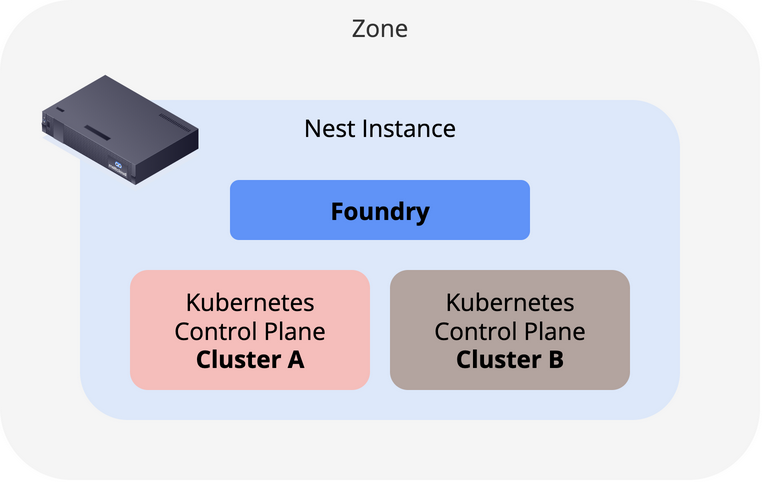
Every setup starts with a single Nest Instance, set up by the Nest installation.
It is a good way to start, but:
- It does not protect from a failing instance: Foundry and the control planes of all Clusters run on it.
- A Nest update restarts the instance, so Foundry and the Clusters' Kubernetes APIs are down for a short time.
Multi-instance
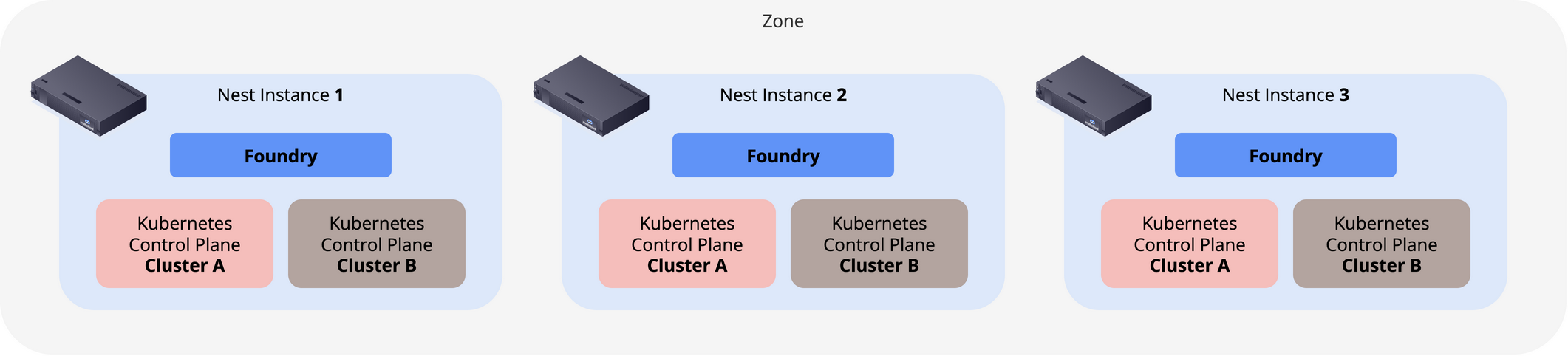
Scale out the Nest to three Nest Instances on separate hosts in a single Zone.
This setup:
- Survives the loss of one Nest Instance. Foundry, its database and its object storage keep running on the other two.
- Updates the Nest and Foundry one instance at a time, without downtime.
- Supports highly available Clusters. Their control planes spread over the instances.
Multi-zone
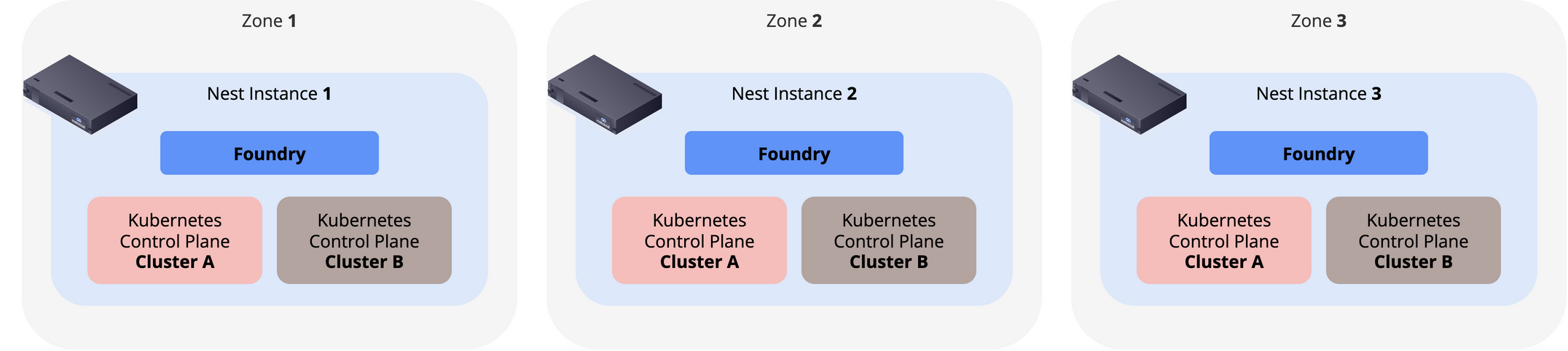
Scale out the Nest over at least two Zones, ideally one instance in each of three Zones.
This setup has the properties of Multi-instance, and:
- Survives the loss of a whole Zone.
- Spreads Foundry and the control planes of highly available Clusters over the Zones.
Support for two Zones
Since many enterprises today have only two DCs, two zones are supported as well; just keep in mind that losing the zone with two instances takes the Nest down.